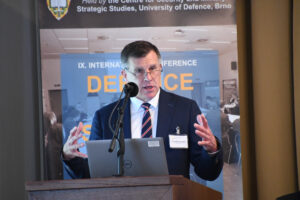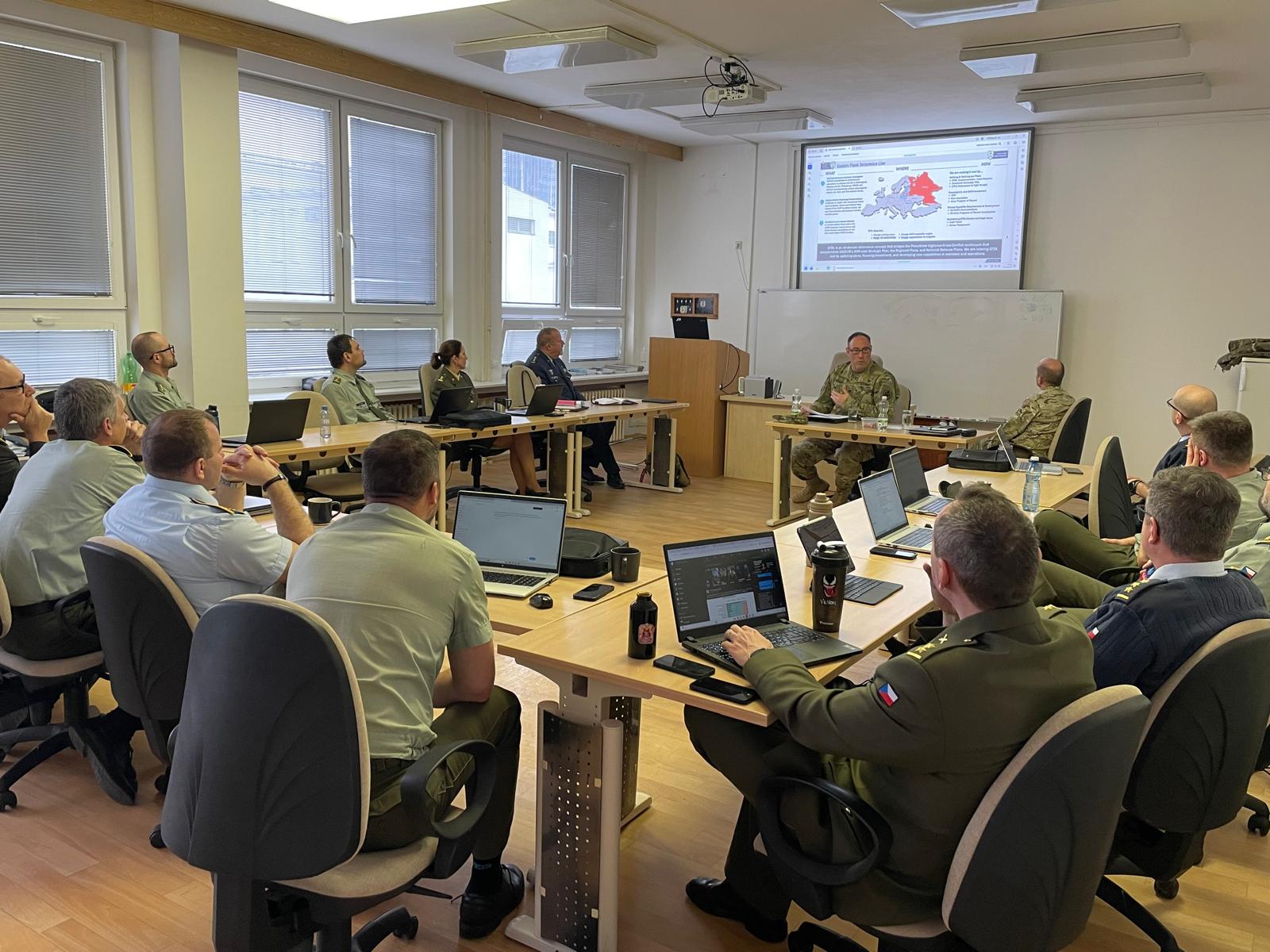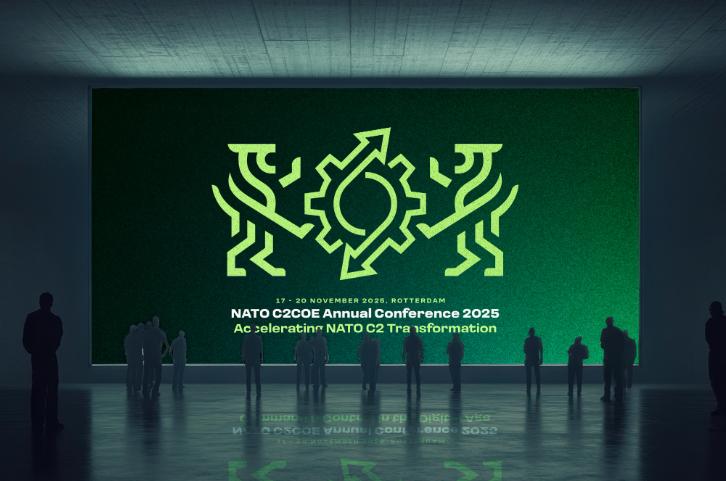
Zdeněk Petráš, PhD., from the Centre for Security and Military Strategic Studies, participated in an international conference held from 17–20 November this year in Rotterdam, the Netherlands, which focused on the future of NATO Command and Control (C2). One of the discussion topics addressed why NATO, in the context of the digital age, needs to transform its C2 and how this transformation should be implemented. A roundtable discussion on this issue, titled Next Generation C2 Innovation — Accelerating Transformation in the Digital Age, was moderated by Zdeněk Petráš, PhD.
In his opening remarks, Zdeněk Petráš, PhD., stated that the key objective of the transformation should be to maintain the Alliance’s strategic advantage and initiative in the current complex security and operating environment, characterised by a high degree of globalisation and rapid technological development. A crucial aspect of this transformation must remain the ability of C2 structures to operate effectively across all operational domains—land, maritime, air, space, and cyber—as well as across the full spectrum of operations. Within the context of the Alliance’s current Multi-Domain Operations (MDO) concept, transforming C2 structures is no longer optional; it represents a strategic categorical imperative. The traditional hierarchical architecture of C2 is increasingly inadequate for conducting multi-domain operations in an environment shaped by advanced technologies, including artificial intelligence.
However, this transformation must strictly reflect the objectives outlined in NATO 2022 Strategic Concept and remain firmly bases on the Alliance’s core principle of collective defence of Allies. From this principle, three key tasks naturally emerge: defence and deterrence, cooperative security, and, importantly, crisis prevention and management. A high level of interoperability is essential within each of these tasks. Interoperability must be clearly understood as a prerequisite for achieving the Alliance’s high military effectiveness and as a necessary condition for joint operations at the tactical, operational, and strategic chains of command. This clearly implies that any initiative aimed at modernising armed forces—whether national or multinational armament programs, or the development of forces and capabilities—must contribute to strengthening NATO’s level of interoperability and standardisation.
Interoperability and standardisation are closely linked to another key factor: military capabilities, meaning the need to ensure required capabilities in the defined quantity and at the appropriate technological level. In this context, it is essential to emphasise the critical role of the NATO Defence Planning Process (NDPP), which serves to identify, develop, and further advance capabilities to fulfil NATO’s level of ambition.
NATO Nations should primarily focus on achieving their commitments to NATO, not only in terms of the designated percentage of GDP but, more importantly, in terms of achieving the required capabilities in accordance with NATO Stanags. Specifically, regarding required capabilities for NATO C2, meeting respective standards at the appropriate technological level is crucial. The Alliance’s strategic advantage and initiative are largely based on technological superiority, which, however, depends on systems that meet NATO standardisation and interoperability requirements. In this sense, the next-generation C2 must enable multinational forces to operate as a consistent and coherent entity.
It is important to emphasise that the next-generation NATO C2 cannot be conceived solely as an automated software system but as a comprehensively integrated system integrating three key elements:
- Advanced technology,
- Clearly defined and efficiently structured processes,
- Educated, experienced, and well-trained personnel.
These three elements create the conditions for achieving capabilities in accordance with the OODA paradigm (Observe–Orient–Decide–Act), i.e., effectively observing, orienting, deciding, and acting against potential adversaries. Achieving such capability is a fundamental building block of decision-making superiority and should be a primary goal of NATO C2 transformation, particularly considering its expected implementation in multi-domain operations.
Thus, achieving superiority in the decision-making process cannot be considered independently of the human factor. Although modern technologies can significantly accelerate situational awareness and support decision-making at all levels, war remains fundamentally a human activity. Clausewitz’s timeless thesis that war is a clash of human wills shaped by emotion, chance, and reason reminds us that technology cannot replace the ability of commanders and their staff based on the principles of operational art. The interpretations of principles of war by other renowned theorists largely align with Clausewitz, emphasising that while advanced technologies can enhance situational awareness and decision-making, human intuition, creativity, and, of course, luck play the dominant role. These, alongside morale, courage, and determination, cannot be replaced by any modern technology or artificial intelligence. The human factor, combined with technology and processes, remains a crucial source of military effectiveness.
From this, it follows that the design of the next-generation NATO C2 must be of Human-Centric Design. Technology should enhance and support commanders’ decision-making abilities. Advanced technological tools must support human judgment, intuition, and creativity rather than replace them. Within this approach, the so-called operational or cross-cutting dimensions—informational, physical, and cognitive—necessary for linking all operational domains in a multi-domain environment, can be compared to Clausewitz’s Trinity. This trinity emphasises the relationship between humans, the military, and politics in war.
The next-generation NATO C2 in the digital age must therefore be based on the effective integration of advanced technologies and processes with the human factor as a key element of the Alliance’s future military effectiveness.
Author: Ing. Zdeněk Petráš, Ph.D.
Illustration: NATO C2COE