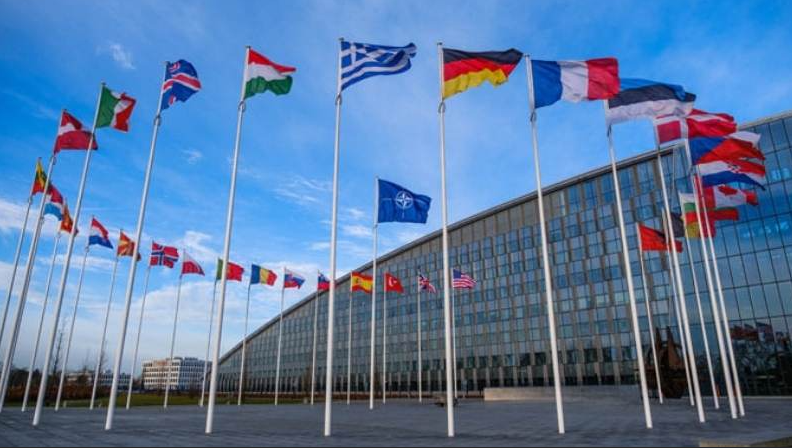
Every year on April 4, we commemorate the founding of the North Atlantic Alliance, known as NATO. The North Atlantic Treaty Organization, established on April 4, 1949, by twelve founding members, is one of the key international security organizations based on the principle of collective defense, whose main goal is to ensure the security of its member states. Even today, NATO plays a crucial role in security matters for a large part of the world, including the Czech Republic.
The North Atlantic Alliance was founded in 1949, just four years after the end of World War II. At that time, the world was already on the brink of the Cold War; it was becoming divided into two opposing blocs—Western and Eastern—between which tensions, uncertainty, and the risk of armed conflict, later even nuclear war, were growing. Western countries therefore sought a way to prevent another military confrontation together. The result was the creation of this security organization, based on a fundamental idea: if one or more NATO member states are attacked, the others will come to their aid. This principle of collective defense is enshrined in Article 5 of the founding Washington Treaty and has become the cornerstone of NATO’s functioning. According to this still-valid article, an attack on one member is considered an attack on all.
Several post-war factors contributed to the establishment of NATO. The primary one was the perceived threat to Western states posed by the Soviet Union and its expansionism, including the spread of communism. Other reasons included the effort to prevent the resurgence of nationalism and militarism in Europe—something supported by the American military presence—and the promotion of European political and military integration to counter the spread of communism, particularly in Western Europe. The creation of NATO thus ensured security for Western European countries while minimizing threats, and for the United States it marked a shift in foreign policy—from isolationism to collective defense and the containment of communism.
At the beginning of its existence, NATO was seen more as a political commitment to defend Europe and ensure stability during the post-war reconstruction period, aiming to prevent unrest and potential political upheavals. The Alliance initially focused on building its internal structures and strengthening its military capabilities for deterrence and defense against Soviet expansion.
Relations among allies were initially complicated as well, as France still viewed Germany as a potential threat (having considered it the main aggressor in three European wars since 1870). Improvement in Franco-German relations first occurred in the economic sphere, when Germany became a founding member of the European Coal and Steel Community in 1952 alongside France, Italy, and the Benelux countries (the Netherlands, Luxembourg, and Belgium). In 1954, the Federal Republic of Germany joined NATO. The Alliance’s southern flank was strengthened in 1952 with the accession of Greece and Turkey, helping increase stability in the Mediterranean. This reflected the successful implementation of U.S. foreign policy in the form of the Truman Doctrine, to which Greece and Turkey aligned. The Truman Doctrine is also considered the beginning of the Cold War and one of the impulses for NATO’s creation. Although the Washington Treaty was not explicitly directed against the Soviet Union, the principle of collective defense and the implementation of the Truman Doctrine clearly oriented NATO toward the East.
Deterioration of relations between Western allies and the Soviet Union had already begun shortly after World War II, influenced by events such as Winston Churchill’s speech in Fulton in 1946, the Soviet-backed communist coup in Czechoslovakia in 1948, and the Berlin Blockade lasting until May 1949. These developments, along with the willingness of Western countries to jointly confront the growing influence of the Soviet Union, led to the formation of the Alliance.
NATO played a key role during the Cold War, when both blocs sought to maintain a balance of power. As a counterweight to NATO, the Warsaw Pact was established in 1955 by eight Eastern Bloc states. This period was marked by nuclear deterrence policies (such as the U.S. concept of mutually assured destruction), international crises (including the Hungarian uprising in 1956, the Suez Crisis in 1956, and the Cuban Missile Crisis in 1962), the Soviet intervention in Czechoslovakia in 1968, and U.S. involvement in the Vietnam War. In 1966, under President Charles de Gaulle, France withdrew from NATO’s military structures to maintain military independence, though it remained in the political structure. It rejoined the military command in 2009 under President Nicolas Sarkozy. France retained decision-making independence in nuclear matters.
During the 1960s, relations between NATO and the European Community were also strained, partly due to France’s opposition to the United Kingdom’s membership, which hindered effective cooperation.
In the 1970s, tensions eased during the period known as détente, culminating in the signing of the Helsinki Final Act in 1975. NATO admitted only one new member during this time—Spain, after the death of dictator Francisco Franco. Détente was supported by West German Foreign Minister Willy Brandt’s Ostpolitik, aimed at improving relations with Eastern Europe and the Soviet Union. Another important factor was the Harmel Doctrine, which emphasized not only strengthening NATO’s defense role but also improving diplomatic relations with Warsaw Pact countries.
After the Cold War, NATO remained highly relevant. Despite major changes in the international system, the Alliance adapted to new challenges such as terrorism, cyberattacks, regional conflicts, and other threats. Following the collapse of the Soviet Union and the Warsaw Pact in 1991, NATO entered a new era. Relations with Russia initially improved, with NATO viewing it as a partner until 2014. That same year, NATO introduced a new strategic concept addressing changes such as German reunification, Baltic independence, the Yugoslav wars, and the Gulf War.
In 1991, the North Atlantic Cooperation Council (NACC) was established to promote dialogue and cooperation with former Warsaw Pact countries. It later evolved into the Partnership for Peace program in 1994, further strengthening cooperation. These initiatives reduced post-Cold War tensions and created a pathway for the integration of former Eastern Bloc countries into European security structures.
A key moment for the Czech Republic came in 1999, when it joined NATO alongside Hungary and Poland. Membership brought increased security guarantees, participation in international missions, cooperation opportunities, political alignment with the West, and military modernization.
From 1991 for nearly two decades, cooperation between East and West flourished. Even after the Kosovo War in 1999, NATO and Russia focused on cooperation rather than confrontation. The NATO-Russia Council was established in 2002. However, a major turning point came in 2014 with Russia’s annexation of Crimea, which disrupted cooperation. NATO suspended practical collaboration and strengthened its military presence in Eastern Europe. Relations worsened further in 2022 following the war in Ukraine, reaching their lowest point since the Cold War.
Today, NATO faces new challenges in deterrence and large-scale defense operations in a rapidly evolving technological and political environment. The Alliance now has 32 members, with Finland joining in 2023 and Sweden in 2024. However, tensions persist among some members, such as between Turkey and Greece.
The European Union remains NATO’s most important partner. Their cooperation includes defense, joint military coordination, crisis response, cybersecurity, and counterterrorism. Key frameworks include the Berlin Plus agreements (2002) and joint declarations from 2018. The EU contributes economic strength and diplomatic capabilities to NATO’s comprehensive approach to both conventional and unconventional threats. Important global partnerships also include cooperation with Japan and South Korea.
As NATO marks its 77th anniversary, it stands as one of the longest-lasting alliances in defense history. Today, NATO is not just about military power—it emphasizes cooperation, conflict prevention, and mutual assistance in crises and natural disasters. Its ability to collaborate and reach consensus is one of the reasons it has endured for over 70 years. The anniversary reminds us that security is not a given, but the result of long-term cooperation, trust, solidarity, and readiness to defend shared values.
Author: Ing. Yvona Novotná, Ph.D.