Dear Readers,
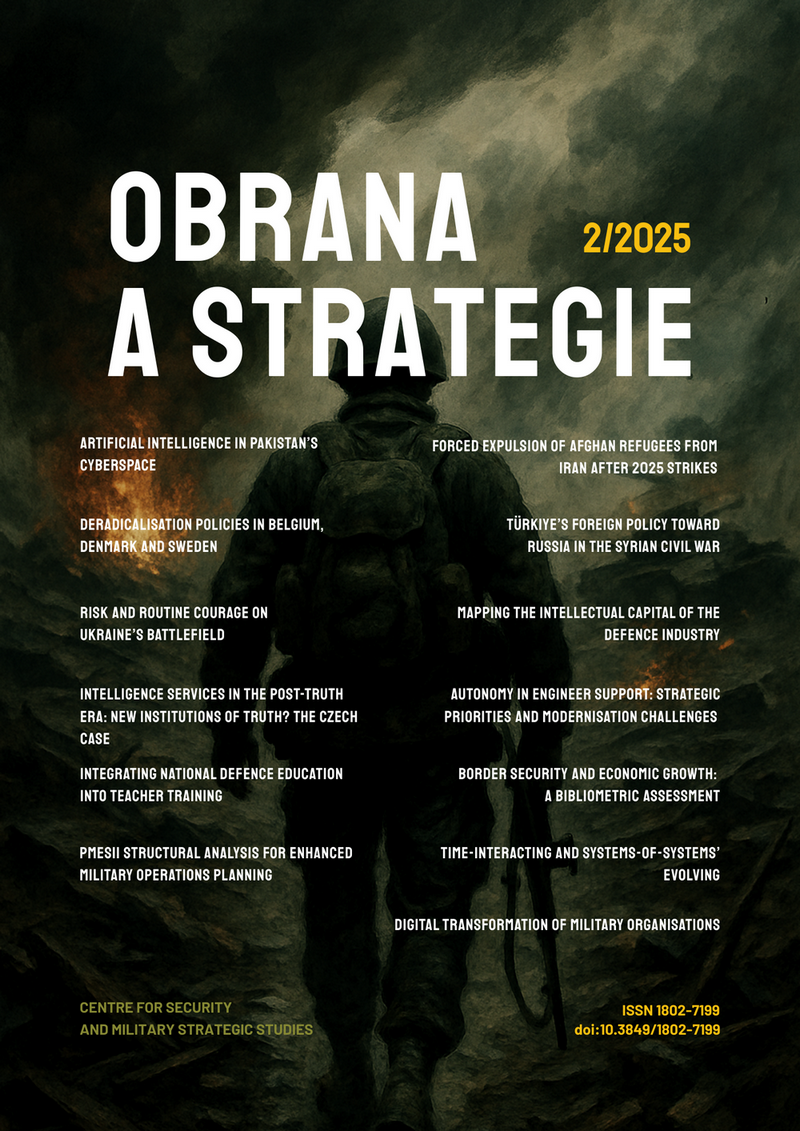
We are pleased to present a new issue that brings together a varied set of peer-reviewed contributions addressing contemporary questions in security and defence from multiple disciplinary and methodological perspectives. Collectively, the articles reflect current debates as well as longer-term challenges, and we trust they will be of practical value to both researchers and practitioners.
The issue opens with “Artificial Intelligence in Pakistan’s Cyberspace: Governance Gaps, Dual-Use Dilemmas, and Strategic Vulnerabilities,” by Sajjad Ahmed, Ahmad Nizar Yaakub, and Asma Javed, which examines Pakistan’s evolving cyber governance and how AI intersects with dual-use security and institutional fragility. Drawing on 16 elite interviews, the authors identify key vulnerabilities and offer policy recommendations focused on doctrine and resilience.
Building on related themes, Cezar Vasilescu in “Digital Transformation of Military Organisations” treats digital transformation as institutional change rather than a narrow modernisation project. Drawing on NATO, EU, and national defence documents, as well as academic literature, the article outlines how emerging technologies are reshaping decision-making while noting persistent implementation barriers.
Pavel Gazárek addresses the challenge of preventing and reversing violent extremism in “Deradicalisation Policies in Belgium, Denmark and Sweden: Lessons for the Czech Republic.” Using qualitative comparative analysis (QCA) with fuzzy sets, the study evaluates programme effectiveness across governance, integration, legal, and trust-related factors and derives targeted recommendations for Czech policy.
From prevention policy to combat behaviour, Jakub Jajcay, in “Risk and Routine Courage on Ukraine´s Battlefield,” examines courage through qualitative observations of soldiers in active combat, focusing on how it manifests in everyday decisions under fire and outlining directions for further research.
A complementary perspective on contemporary information conditions is developed by Libor Kutěj, Karel Pešek, and Robin Šmíd in “Intelligence Services in the Post-Truth Era: New Institutions of Truth? The Czech Case.” Analysing media outputs and public reactions from 2017–2025, the authors assess how transparency and strategic communication affect democratic resilience and legitimacy, and argue for accessible and apolitical communication.
The domestic resilience agenda is pursued in “Integrating National Defence Education into Teacher Training: Opportunities and Challenges for Preparing Citizens in the Czech Republic” by Pavel Otřísal and Vojtěch Loyka. Anchored in the Concept of Preparing Citizens for National Defence 2025–2030, the article analyses implementation pathways within teacher education and proposes approaches intended to strengthen preparedness.
Methodological innovation in planning is the focus of Petrișor Pătrașcu in “PMESII Structural Analysis for Enhanced Military Operations Planning.” Applying Prospective Structural Analysis with expert validation and MICMAC mapping, the study identifies drivers and leverage points across PMESII domains to improve scenario development in complex operational environments.
Human security and international protection norms come to the fore in “Forced Expulsion of Afghan Refugees from Iran after 2025 Strikes” by Sabza Gol Qaderi, Sidik Jatmika, and Mohammad Rafi Hammidi. The study examines impacts on Afghan refugees in Iran following the June 2025 strikes and highlights risks associated with forced repatriation, stressing coordinated responses and adherence to non-refoulement.
The issue also advances interpretive approaches to foreign-policy analysis. In “Türkiye’s Foreign Policy Toward Russia in the Syrian Civil War,” Denisa Sarı, Libor Kutěj, and Petr Stodola analyse official discourse (2014–2024) to trace evolving identities and legitimising narratives shaping Türkiye’s stance.
Two contributions use systematic mapping methods to clarify intellectual landscapes. “Mapping the Intellectual Capital of the Defence Industry: A Systematic Literature Review and Bibliometric Analysis” by José Ramón Sasián and Encarnación Ramos-Hidalgo surveys the field through a structured review and bibliometric analysis. In a related bibliometric vein, “Border Security and Economic Growth: A Bibliometric Assessment” by Himanshu Thakkar, Saptarshi Datta, and Anjani Devi analyses a Scopus dataset to examine how border security research connects to economic resilience and growth.
Operational and doctrinal lessons from the Russia–Ukraine war are synthesised in “Time-Interacting and Systems-of-Systems’ Evolving: Lessons Identified from the Russian-Ukrainian War (2022–2024)” by Volodymyr Tymchuk, Ihor Sashchuk, Yevhen Mezhevikin, which frames warfare as an evolving system of systems and highlights integration challenges and rapid capability cycles.
The issue concludes with “Autonomy in Engineer Support: Strategic Priorities and Modernisation Challenges” by Martin Sedláček, Michal Bilina, and Petr Demel, which focuses on autonomy as a capability priority and proposes a framework to support strategic alignment and modernisation decisions in engineer support.
We trust that the research presented in this issue will stimulate informed debate and encourage further inquiry into the security and defence challenges shaping contemporary policy and practice.
On behalf of the editorial board, I would like to thank you, our readers, for your continued interest and support, and I wish you all the very best for the New Year 2026.
Chairman of the Editorial Board