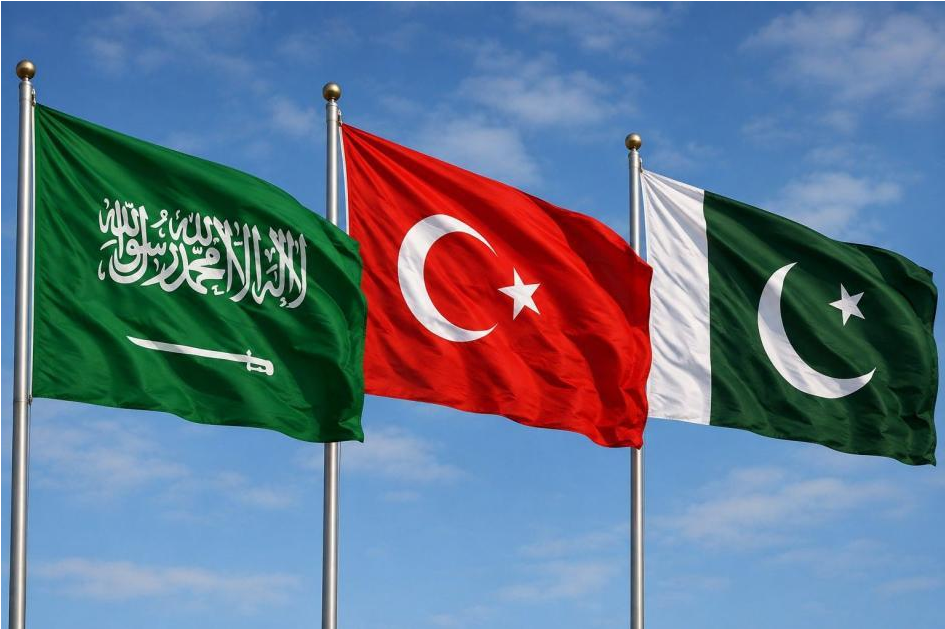
The security architecture of the Middle East and the Gulf region is currently undergoing a profound transformation. The Mecca Joint Defence Agreement, signed on 7 August 2026 by major regional actors, namely Türkiye, Saudi Arabia, and Pakistan, represents a significant step toward the institutionalisation of a new regional security framework. The agreement reflects regional powers‘ growing ambition to deepen security cooperation, enhance strategic autonomy, and diversify existing security partnerships.
The agreement’s primary objective is to strengthen collective deterrence against any act of aggression. It further stipulates that an armed attack against one of the three signatory states shall be regarded as an attack against all of them. In late August 2026, the parties established a Strategic Political and Defence Commission, agreed to create a permanent secretariat headquartered in Saudi Arabia, and endorsed expanded cooperation in defence, defence-industrial development, technological innovation, and building a broader institutional framework.
This newly signed agreement highlights several important developments. For decades, the regional security architecture relied heavily on the United States as the principal guarantor of security. However, the current system increasingly reveals limitations and deficiencies from regional actors‘ perspective. As a result, a new strategic reality is emerging in which the United States no longer holds an exclusive position in nuclear deterrence. Under the logic of this new arrangement, another nuclear power, Pakistan, now partially assumes this role.
For the United States, the Mecca Agreement represents a significant adjustment in its Middle Eastern policy, though not a loss of its overall strategic position in the region. This development may be interpreted as the end of an American monopoly on regional security management rather than the end of American dominance. The United States still possesses military capabilities that no other state can realistically replace in the short term and remains the region’s principal diplomatic and military power. Regional states are therefore not abandoning their partnerships with Washington. Rather, in response to the evolving and often unpredictable nature of contemporary U.S. foreign policy, they are adapting and diversifying their alliances to mitigate vulnerabilities and reduce strategic dependence.
The decline of the American monopoly over nuclear deterrence may be understood as one of the long-term consequences of U.S. foreign policy in the Middle East. In particular, it can be linked to the ongoing U.S.-Israeli war against Iran. The United States and Israel launched air strikes against Iran in June 2025, and by 28 February 2026 the conflict was still continuing. The war has caused substantial economic losses and disrupted the global economy, international trade, and transportation. At the same time, the United States has struggled to shield its Arab partners from Iranian retaliation to the extent many regional allies expected from the principal guarantor of regional security.
In this context, the Mecca Agreement may be viewed as an alternative approach to the U.S.-Israeli strategy of containing Iran. All three participating states, Saudi Arabia, Türkiye, and Pakistan, share either land or maritime borders with Iran, and their relations with Tehran have been shaped since the 1979 Iranian Islamic Revolution by a complex mixture of religious, political, strategic, and geopolitical factors. Saudi Arabia in particular has historically pursued a policy aimed at limiting Iranian influence and preventing the export of the Iranian revolutionary model to neighbouring Arab and Muslim countries.
Nevertheless, the United States officially welcomed the Mecca Agreement, as it creates greater opportunities for burden-sharing and regional responsibility for security. Effective burden-sharing, however, can function only with a common strategic vision, and such a comprehensive strategy has not yet been fully developed within the framework of the new arrangement.
The emergence of the Mecca Agreement may therefore be regarded as a highly significant regional development whose importance extends beyond symbolic declarations. It points to a new direction in the evolution of Middle Eastern security architecture, one in which regional groupings are increasingly acquiring strategic actorness and emerging as autonomous centres of power. Establishing a permanent secretariat is particularly important in this regard. It represents a move toward deeper institutionalisation and a more durable organisational structure capable of coordinating joint activities, facilitating communication among member states, supporting collective decision-making, and implementing long-term strategic objectives. From a strategic actorness perspective, the secretariat could strengthen the organisation’s ability to operate cohesively, develop long-term policies, and respond more effectively to political and security crises in the region.
At the same time, the signing of the Mecca Agreement should not be interpreted as the creation of a new “Muslim NATO.” Its ultimate effectiveness will depend on several critical factors, including the establishment of mechanisms for joint planning, the achievement of interoperability among the armed forces of the three member states, the development of consultation procedures, and, above all, the political willingness of member states to fulfil their commitments and bear the costs associated with collective defence. While the agreement seeks to introduce common mechanisms across several areas of cooperation, it does not yet constitute a fully integrated military command structure.
The Mecca Agreement therefore represents an important step in the ongoing transformation of security architecture in the Middle East and the Gulf region. Its significance lies in promoting collective defence principles, diversifying strategic partnerships, strengthening regional strategic actorness, and gradually reducing dependence on a single external security guarantor. Although the United States remains the most influential diplomatic and military actor in the region, its relative influence is gradually declining. Other major powers, including Russia and China, may supplement aspects of the regional balance of power, but neither is currently in a position to replace or assume the overall role of the United States.
The European Union, despite its considerable economic strength, extensive diplomatic network, and geographical proximity, is still often perceived in the region as an actor that largely follows U.S. strategic priorities, including policies toward Israel, rather than as an independent and credible strategic actor in its own right.
Ultimately, the purpose of the Mecca Agreement is not to replace American predominance with another great power. Rather, it seeks to gradually create a regional environment in which Middle Eastern states have greater capacity to formulate their own security policies and shape the future of regional security relations according to their strategic interests.
Author: Ing. Yvona Novotná, Ph.D., Centre for Security and Military-Strategic Studies, University of Defence
Notes
In September 2025, Saudi Arabia and Pakistan signed a bilateral defence treaty, which Türkiye subsequently acceded to, creating the basis for the Mecca Agreement.
This provision closely resembles Article 5 of the North Atlantic Treaty establishing NATO.